
Trusting Your Midlife Chicken Wings
A therapist's guide to flying in midlife, even when you feel "chicken"... Or: when a mother hen remembers she has wings.

Most mornings, I write in silence, the only sounds the clickity-clack of the keyboard and the thoughts in my head, audible only to me. Today, as I claim a free afternoon to write, a small barking dog beneath my office window is trying to derail those efforts by stealing my peace as I sit down to collect my thoughts.
But I will not be thwarted.
So, in defiance and with the “tenacity of a turtle,” as my dad would say, to reclaim this time to write, I put in my earbuds to drown out the tiny dog barking outside my office. These small devices, which are normally reserved for my runs, today serve as a barrier to the squeak of “the mad king,” as I have nicknamed him, as I listen to “70’s disco classics”, the familiar music of my youth.
Now, time to bring in the breath to regain my peace…
Deep breath in - hold. Exhale slowly.
Repeat… and repeat three or four more times…
Connect to the feeling of peace.
Find the calm.
Feel the sensations of loosening and sway my body to the music.
And…. there we are again, in the flow and hearing my internal voice, nervous system reset, despite the initial barking which almost thwarted my efforts and peace.
Conscious breathing resets us.
Funny how music can do this, too.
As I listen to songs from my childhood, I am suddenly transported to my roller-skating days, shoulders moving to the beat, feeling a familiar freedom and sense of peace and joy.
I get nostalgic when listening to music of my youth, growing up in a time that seemed simpler and wilder in some ways. We were mostly left to our own devices to explore life. In some ways, this is exactly how I feel now in midlife, a “reset button” much like the intentional breathing above, but now with the wisdom of decades shoved in our back pockets.
I awoke from a dream about my parents this morning, and I often wish they were here to impart their wisdom into my life in times of uncertainty or just to sprinkle in some drops of advice or comfort. Now, alone at the top of the family totem pole, I find it disorienting at times, for I certainly don’t feel wise, but I do feel there are lessons life has thrown at me that, after many mistakes, I eventually learned.
As a mother of many, I feel a certain fear about the world our children are entering today. But then I wonder if this was the same sentiment my parents felt. Perhaps every generation stands at the edge of their children’s futures, hoping their wings are strong enough. And in my 50s, as a nomad, living in borrowed spaces, I too am now testing the strength of mine…my second-season wings.
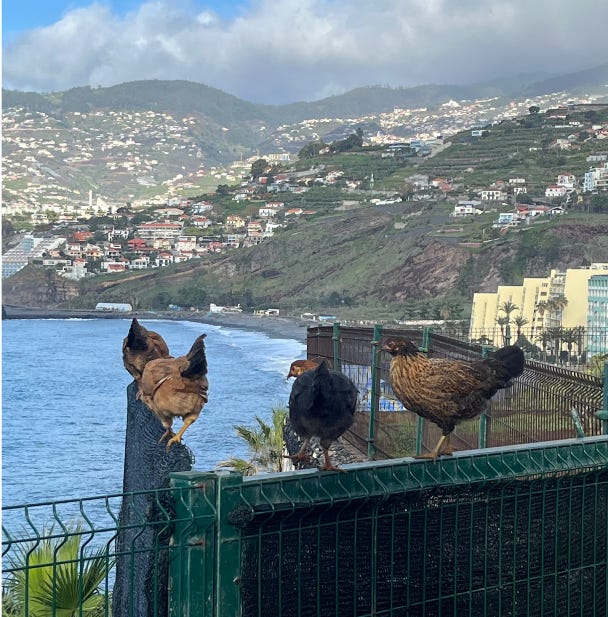
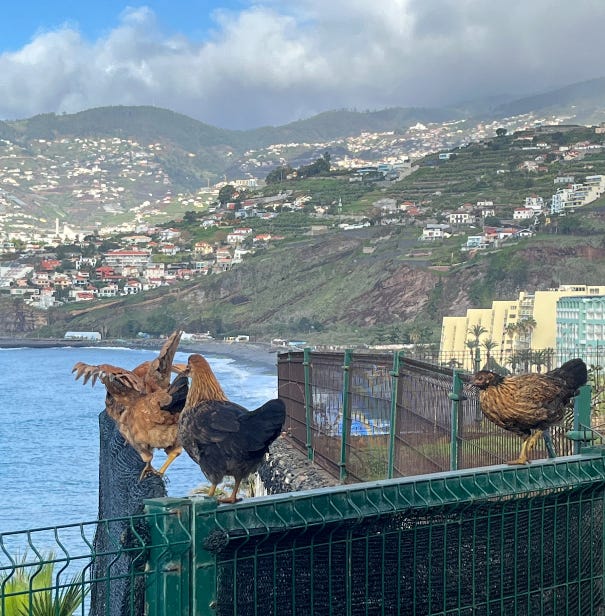
When we first arrived in Madeira, I spotted a rooster and hen in a touristy spot where people would stop and take pictures of the ocean in the background. One day, a few months ago, I saw nine baby chicks surrounding the mother hen and almost lost myself in excitement. I’ve always wanted to have chickens, but I’ve never had them, and watching these chickens was about as close as I imagined I’d get at this point in my life.
Every day, on our walk to the beach for a chinesa, I looked for my “babies,” stopping to observe them for several minutes each day as I watched them grow over the last several months. I often wondered whether they would still be there as they grew, or if something would happen to them, or how long they would stay near their chicken parents.
I wondered when they would fly away in a labored, fluttery leap to start their own adult chicken lives. I was fascinated watching them grow and seeing them out in the wild, living so freely on the side of a cliff in a very touristy spot on the island, and I couldn’t help but think of my own “chickens” ( I playfully call my own children my chickens), in parallel with me as the mother hen guarding and guiding until they eventually flew off to begin their own lives.
But here’s what I started noticing: these actual chickens aren’t chicken about anything. They venture into pedestrian walkways. They peck at whatever interests them. They don’t ask permission to explore the world. They just... go. Meanwhile, I - the human watching them - have been being chicken about a hundred different things in my life… we all do at times.
We use “chicken” as an insult for cowardice, but the irony is that chickens themselves are remarkably brave explorers when given the chance.
Listening to disco music, writing, and feeling nostalgic has me thinking about my now nomadic life and how I never thought I would be sitting in an apartment overlooking the ocean on a random Friday afternoon with earbuds in, listening to disco and writing about chickens and life from this point of view. My own labored, fluttery leap into the great unknown a few years ago felt paralyzing, but now feels life-giving to me, my husband, and our “chickens” as well.
And for years, I was being chicken about my own dreams while protecting everyone else's.
But that fear of failure, of flying and testing your wings, can be strong enough to keep you from taking the first uncertain step (or labored, fluttery leap) in life when staying close to familiarity feels safer.
As a therapist, I realize this is what many others struggle with when making big decisions in life: But what about my kids? What will other people think? What about disappointing others if I choose something for myself?
I see this all the time. I understand it. I identify as the mother hen, too.
What’s interesting about watching these island chickens is the parallel I see with my own children’s growing independence while my husband and I are on this grand adventure, ourselves testing out our flight wings.
We are all watching each other fly in labored, fluttery leaps.
All of us are leaving the safety of the nest to see what’s around the bend.
My parents didn’t travel. They stayed put. So did their parents before them. We circled them like chicks circle the mother hen. It felt good. Comforting. Secure.
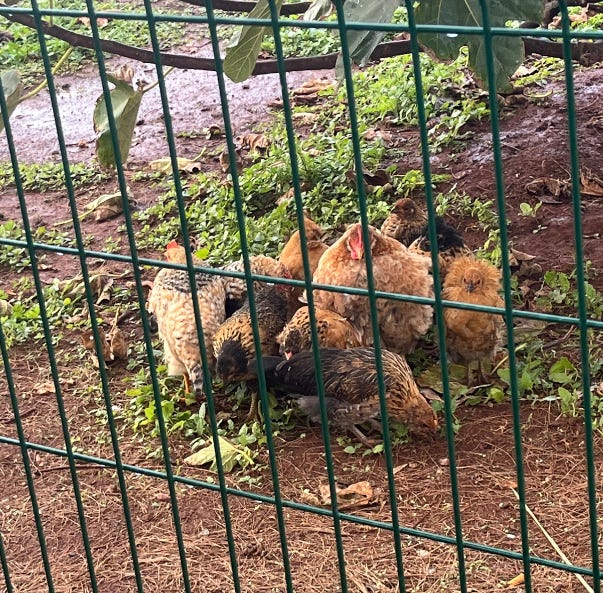
But something interesting is happening with our own kids, just like these real chicks I’ve been watching for weeks… one by one, they’re flying the nest. And I haven’t seen Mom and Dad chicken either for a few days…
Like these island chickens, we are creating new patterns for our children to model. New ways to live and explore life. New wings to try out and test to see if they indeed can support our dreams.
There is something that happens when we give ourselves permission.
Whether it’s writing, traveling, changing careers, leaving a toxic relationship, or starting our own business… or something as simple as not wearing make up anymore to feel beautiful (a new quiet rebellion of not caring I am experimenting with)… there’s a process of trusting ourselves with our decisions that sometimes leaves us paralyzed, filling in the blanks with the proverbial “but what if...”
In essence… being chicken
Psychologists call this identity foreclosure, when we lock into roles defined by others’ expectations rather than our own exploration. We become so identified with being the “responsible one,” the “good mother,” the “stable employee” that we forget these are roles we’re playing, not the entirety of who we are. The fear isn’t really about disappointing others. It’s about the terrifying freedom of discovering we might want something different from what we thought we wanted.
When I left my own nest after college, I took a job on the other side of the country. My father looked me squarely in the eyes, told me I had a “good head on my shoulders,” and said, “The road always goes both ways.” He gave me permission to trust my wings. He gave me the courage to test flying on my own and the comfort that I could return to the nest if I ever needed to.
What my father understood intuitively, psychologists have now proven through decades of research: autonomy support, the belief that we’re capable of making our own choices and that those choices are reversible, is one of the strongest predictors of well-being and life satisfaction. When someone we trust tells us, “You can handle this, and you can change your mind,” they’re not just being kind. They’re activating our intrinsic motivation, the internal compass that guides us toward what genuinely matters.
That is one of the hardest things to do as a parent - to let go.
But it’s also one of the hardest things to do in midlife: to reach for something new.
Research on adult development shows that midlife isn’t a crisis; it’s actually a critical period of generativity, the psychological need to create, contribute, and leave something meaningful behind. The restlessness we feel isn’t dysfunction. Its development. It’s our psyche saying, “You’ve mastered survival. Now what will you create?”
While we may be on this nomadic adventure, we are all nomads in some ways.
I may be living on the other side of the ocean from where I grew up, but I didn’t forget my roots, my childhood, my roller skating to the classic rock song by Lynyrd Skynyrd from 1973, “Freebird.”
“‘Cause I’m as free as a bird now…”
But being a nomad doesn’t require a passport.
It simply means permitting ourselves to change our lives at any point.
To pivot in our careers.
To take the challenge to open a business.
To be brave enough to start over.
Neuroscientists have discovered something amazing about our brains: they remain plastic… capable of change, throughout our entire lives. But here’s the catch: neuroplasticity requires novelty. Our brains literally need new experiences to form new neural pathways.
When we repeat the same patterns, we strengthen the existing highways in our mind.
When we do something different, even something small, we create new routes, new possibilities, new versions of ourselves.
These small permissions accumulate.
Psychologists call this self-efficacy, the belief in our capacity to execute behaviors necessary to produce specific outcomes. But self-efficacy isn’t built through grand gestures or dramatic life changes. It’s built through what researcher Albert Bandura called “mastery experiences”, small wins that prove to ourselves we can handle uncertainty, tolerate discomfort, and survive change.
Each time you take a different route, you’re teaching your nervous system: novelty is safe.
Each time you say no to obligation and yes to passion, you’re rewiring the belief: my desires matter.
Each time you try something new and survive the awkwardness, you’re proving: I can be a beginner again.
These small permissions create a practice of trusting yourself and remembering that you, too, have a “good head on your shoulders” and that the road always goes both ways. You don’t have to move across the ocean to explore creating newness in your own life…newness that makes you want to put on your dancing shoes and gives your shoulders a little wiggle, reminding you what it feels like to be young and free again.
Now, at this stage in life, watching my grown chickens start to explore life on their own terms, I feel the exhale. I feel the permission to once again, as I did in my twenties, find my new song, new passions, and take a fluttery leap into the unknown.
I’m in the space of giving myself permission to turn inward and ask the questions I did when I was younger, with the same eagerness to see what’s next.
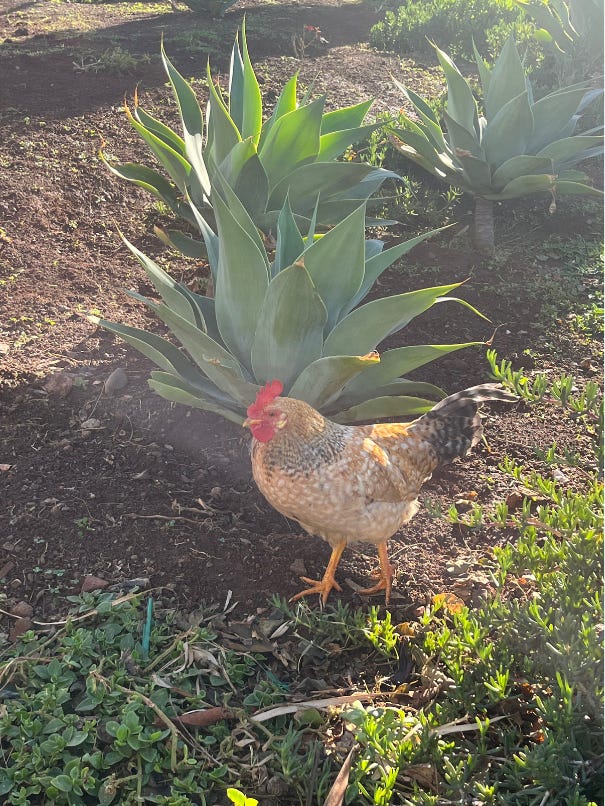
The mother hen on the island doesn’t clutch her chicks closer as they grow. She models what it means to scratch at the earth, to explore, to trust her instincts. She gives them permission by example.
And perhaps that’s what we do best in midlife, not by holding tight to what was, but by showing what it looks like to keep growing, to keep flying, to keep permitting ourselves to evolve.
Attachment researchers call this being a secure base, a reliable presence that doesn’t restrict exploration but instead makes it possible. We become this for our children not by sacrificing ourselves, but by demonstrating that growth doesn’t end when responsibility begins.
When our children see us take the leap to do new things, change the route, say no to what drains us, they learn something more valuable than any advice we could give them: it’s never too late to test out those wings.
Maybe you feel “stuck” right now…. feeling like a chicken in some parts of your life.
That’s okay. We all do at certain times in our lives.
But stuck is just another word for “gathering your strength before the next flight.”
Psychologist William Bridges wrote about transitions having three phases: an ending, a neutral zone, and a new beginning. The neutral zone, what we call “stuck”, is actually where the most important psychological work happens. It’s the chrysalis stage. It feels like nothing is happening, but beneath the surface, we’re reorganizing our entire sense of self.
We’re not stuck.
We’re integrating.
The discomfort of this in-between space is actually evidence that we’re doing the hard work of becoming.
Listening to disco, thinking about my childhood, remembering how my parents let me go to make my own life, how now I’m the “wise” elder hen doing the same with my chicks, writing it all down on a Friday afternoon…it feels like enough today. And maybe that’s the most nomadic principle of all: knowing when enough is exactly right, when staying put is its own form of movement, when the smallest gesture of self-permission is actually the bravest journey.
The road always goes both ways.
But you have to take the first step (or labored, fluttery leap) to know which direction calls to you.
Trust those tiny wings to support your dreams, too, whether that’s a small pivot or a leap to new lands.

P.S. Looking for more tools and support as you design the life of your dreams? You can pick up my one-year guided journal HERE.
xo,
-Jada
P.P.S. I always love hearing your thoughts and welcome comments! I also greatly appreciate your sharing!
I love how all the psychology references fit so perfectly in a travel context. I’m publishing a piece tomorrow on another one: learned helplessness, and how to combat it with fierce action. Your piece reminds me of David Whyte’s poem "Start Close In." I’ll share the first stanza:
Start close in,
don’t take the second step
or the third,
start with the first
thing
close in,
the step
you don’t want to take.
This is such an impactful metaphor — and I love how you wove the science into something so lived and tender.
“We use ‘chicken’ as an insult for cowardice, but the irony is that chickens themselves are remarkably brave explorers.” That line really stayed with me. So many of us in midlife are quietly doing brave things while still calling ourselves scared.
Your father’s “the road always goes both ways” feels like the kind of permission that echoes for decades. It mirrors something I’ve found in this nomadic season too — most of the leaps that felt irreversible weren’t. They were adjustable. Reversible. Survivable.
I’m curious — do you think watching your children take their own fluttery leaps has made it easier for you to take yours? Or harder?
I’ve found there’s something powerful about mutual flight — parents and grown kids all testing wings at the same time. It feels less like abandoning the nest and more like expanding it.
Beautiful work here.
— Kelly 💛